
Enzymes
The biological processes that occur within all living organisms are chemical reactions, and most are regulated by enzymes. Without enzymes, many of these reactions would not take place at a perceptible rate. Enzymes catalyze all aspects of cell metabolism. This includes the digestion of food, in which large nutrient molecules (such as proteins, carbohydrates, and fats) are broken down into smaller molecules; the conservation and transformation of chemical energy; and the construction of cellular macromolecules from smaller precursors. Many inherited human diseases, such as albinism and phenylketonuria, result from a deficiency of a particular enzyme. Enzymes also have valuable industrial and medical applications. The fermenting of wine, leavening of bread, curdling of cheese, and brewing of beer have been practiced from earliest times, but not until the 19th century were these reactions understood to be the result of the catalytic activity of enzymes. Since then, enzymes have assumed an increasing importance in industrial processes that involve organic chemical reactions. The uses of enzymes in medicine include killing disease-causing microorganisms, promoting wound healing, and diagnosing certain diseases
Metabolism of Biomolecules
Before we study the details of metabolism, we must review the structure and functions(Chemistry) of
the four major classes of biomolecules.
Introduction
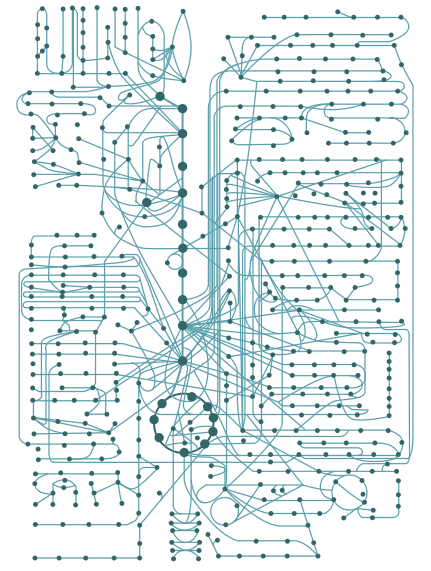
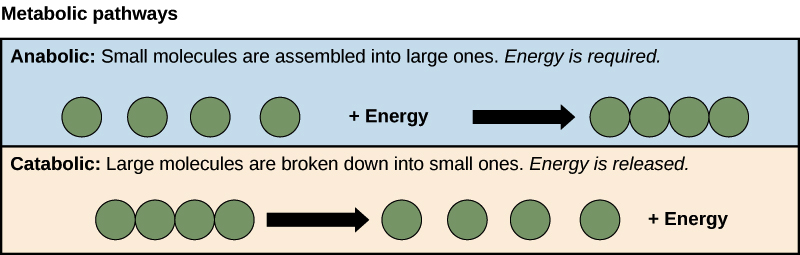
Overview of metabolism
Anabolic and catabolic pathways
Nutrition
Nutrition is a science of food and its relationship to health. Nutrition refers to nourishment that
sustains life. The study of nutrient requirements and the diet providing these requirements is also
known as ‘nutrition’. It includes the uptake of food,
liberation of energy, elimination of wastes and all the processes of synthesis essential for
maintenance, growth and reproduction.. It is a relatively new science
with roots in physiology and biochemistry and is interrelated to various other subjects like
Medicine, Agriculture, Food science & technology, Biochemistry, Biological sciences,
Economics, Psychology, etc.
‘Balanced diet’ is defined as that ‘diet providing adequate nutritional needs as well as extra
allowance for stress from different foods belonging to different food groups in specific quantities
and proportions’. Since all foods don’t have similar nutritional quality, the nutrients provided
and thus the health depends on the choice & quantity of foods selected. For a healthy & active
life, diets should be planned on sound nutritional principals. Optimum nutrition /adequate
nutrition or good nutrition is a diet “that provides all dietary nutrients in respect of kind and
amount, and in proper state of combination or balance, so that the organism may always meet the
varied exogenous and endogenous stresses in life, whether in health or disease, with a minimal
demand or strain on the body’s natural homeostatic mechanisms”. Thus while
planning the diet, in addition to the calorific value, the quantity and quality of food(Vitamins & Minerals) is taken into
consideration. The three proximate principles of food are Protein, Carbohydrate and Fat. The
main energy food sources are carbohydrate and fats; whereas for growth and development
protein food sources are required. Deficiency, excess or imbalance of nutrients results in
malnutrition, which could be either under nutrition or overnutrition. Proper nutrition is required
for prevention of illness as well as for treatment of the illness.
Vitamins
Vitamins are organic compounds. Although they are required in small amounts, but are essential
for many important functions of the body. They can not be synthesized by the body. Due to
shortage of specific vitamins various deficiency diseases could occur. The vitamins were
designated by letters A, B and so on before their structures were determined. Foods contain small
quantities of these vitamins.
Minerals are required for many purposes like forming the frame and rigid structure of the body,
as part of the body/cell fluids and for number of cellular and sub cellular physiological functions.
Homeostasis
Homeostasis, any self-regulating process by which biological systems tend to maintain stability while adjusting to conditions that are optimal for survival. If homeostasis is successful, life continues; if unsuccessful, disaster or death ensues. The stability attained is actually a dynamic equilibrium, in which continuous change occurs yet relatively uniform conditions prevail.
Water is made up of 2 hydrogen atoms and 1 oxygen atom (Figure 3.1 “The Water Molecule”). A human body is made up of mostly water. An adult consists of about 37 to 42 liters of water, or about eighty pounds. Fortunately, humans have compartmentalized tissues; otherwise we might just look like a water balloon! Newborns are approximately 70 percent water. Adult males typically are composed of about 60 percent water and females are about 55 percent water. (This gender difference reflects the differences in body-fat content, since body fat is practically water-free.
Fluid and Electrolyte Balance
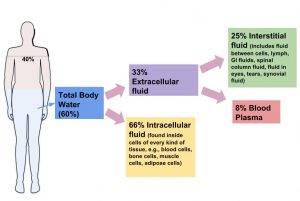
Although water makes up the largest percentage of body volume, it is not actually pure water but rather a mixture of cells, proteins, glucose, lipoproteins, electrolytes, and other substances. Electrolytes are substances that, when dissolved in water, dissociate into charged ions. Positively charged electrolytes are called cations and negatively charged electrolytes are called anions. For example, in water sodium chloride (the chemical name for table salt) dissociates into sodium cations (Na+) and chloride anions (Cl−). Solutes refers to all dissolved substances in a fluid, which may be charged, such as sodium (Na+), or uncharged, such as glucose. In the human body, water and solutes are distributed into two compartments: inside cells, called intracellular, and outside cells, called extracellular. The extracellular water compartment is subdivided into the spaces between cells also known as interstitial, blood plasma, and other bodily fluids such as the cerebrospinal fluid which surrounds and protects the brain and spinal cord (Figure 3.2 “Distribution of Body Water”). The composition of solutes differs between the fluid compartments. For instance, more protein is inside cells than outside and more chloride anions exist outside of cells than inside.
ACID–BASE BALANCE
Maintenance of acid–base balance is fundamental for the normal functioning of biological processes, mainly due to the pH dependence of enzyme function. This article reviews definitions of acid–base balance and describes normal physiology of acid–base metabolism in the extracellular fluid and blood. The individual roles of the kidney, liver, bone, and lungs in maintenance of acid–base balance are outlined in detail in both health and disease. The pathogenesis of common conditions (diabetes, renal failure, drug intoxication) affecting acid–base balance are assessed as well as potential treatment strategies. The impact of dietary intake on acid–base status is also discussed.
Molecular Biology
The field of molecular biology has a profound impact in medical science investigation. Major advances in molecular biology over the last four decades have stimulated research and progress in almost all the disciplines of life science.
This driving force involves:
(1) the development of more and more sophisticated experimental techniques in molecular biology with a broad, interdisciplinary applicability;
(2) the ever-expanding flow of information of technical novelties and scientific discoveries across the scientific community; and
(3) the development of specific software and continuously updated databases for, respectively, analyzing and storing data on genotypes, gene expression levels, cytogenetic profiles and other molecular features.
This has changed the rationale and approach of scientific experimentations allowing revolutionizing discoveries not only in molecular biology but also in biochemistry, biophysics, biotechnology, cell biology, and genetics. One major example is the innovation in high-throughput biology, next generation sequencing and recombinant DNA technology, which made possible to unveil the high complexity of the genome and elucidate the precise mechanisms for the transmission of the genetic information. So, it is now proven that gene expression, DNA replication, DNA repair, and sister chromatid segregation are processes much more complicated than previously thought.
This complexity includes, but is not limited to:
(1) the existence of interconnected regulatory pathways involving also previously unexpected actors, such as non-coding RNAs;
(2) the relevance of epigenetic mechanisms and post-transcriptional modifications;
(3) the importance of the correct execution, timing, sequentiality and coordination of all cell cycle events;
(4) the pleiotropic functions of players operating in these processes; and
(5) the influence of the energetic metabolisms and environmental signals. Moreover, it has become evident that the deregulation of these molecular processes is associated with, and in certain circumstances is the direct cause of, a wide range of pathological conditions. Although this module is focused on life sciences, it is, however, necessary to mention the biomedical relevance of molecular biology-related investigations for drug discovery and the development of a more personalized medicine.
Given the rapidly changing and continuously evolving nature of the molecular biology field, we can anticipate that the revolutionary impact of molecular biology in medical sciences is only at the beginning and is far from being finished.
Organ Function Tests
This chapter provide a comprehensive view of vital organs with respect to their location, their importance and functions in the body; their respective disorders, diseases and various function tests.it provides basic knowledge on various routine function tests like Liver Function tests, Kidney Function tests, Thyroid Function tests, Adrenalin Function tests, Pancreas Function tests and Gastric Function tests. A few metabolic disorders have also been touched upon.
Biochemistry: Intra-departmental Moodle Training
This space will be a training "trial and error" playground for all faculty members to practise what they learn via the training videos. Any mistakes are reversible, so one need not worry about going ahead and exploring the software via this course.
Maternal and Child Health, Geriatrics
Nutrition and Health
Non-communicable Diseases
Clinico-social cases AND Field Visits
Basics of Biostatistics
Epidemiology, Epidemiological Methods AND Screening of Diseases
Course contains teaching sessions dealing with Principles of Epidemiology & Epidemiological Methods and screening of diseases.
Communicable Diseases
Course deals with teaching sessions on Epidemiology, Prevention & Control of Communicable Diseases.
ASSESSMENTS
Course contains assessments given to the students by faculty.